lunes, 16 de marzo de 2020

Ultimate Epic Battle Simulator Free Download

Ultimate Epic Battle Simulator - is a battlefield simulation game from the year 2017. Here is a sandbox like no other. Create massive battles with absolutely no limits. Want to see 10,000 chickens fight an army of Romans?


Featuring: There are simply no limits to the carnage you can achieve in Epic Battle Simulator. Mess around with a massive variety of units. Everything from, Roman Centurions, Medieval soldiers, Knights, Orcs, Trolls, and yes, chickens! The main focus in this game is giving the player no restrictions to what he can do and that is why we decided not to limit the amount of units in battle. Want to see what a battle of 100,000 units looks like? Plus we don't recommend going past 10,000 for most machines but its your CPU, do what you want.
1. FEATURES OF THE GAME

• Play as any one of the units in the Game and getting up close plus, Personal to help change the tides of a battle.
• Unfortunately, there aren't many engines that you can chuck 10,000 characters in and Expect good performance.
• Each individual in this video game decides his own path plus, navigates or react in Massively open environments.
• Plus some multiple troops are available to choose from and more to come it is totally up to you to build your army.
• Mess around with variety of units. Everything from, Roman Centurions, Medieval soldiers, Knights, orcs and trolls.

Game is updated to latest version

Important Notes

▪ Proper crack by Codex or Reloaded + game fix by viciomnia.

2. GAMEPLAY AND SCREENSHOTS
3. DOWNLOAD GAME:

♢ Click or choose only one button below to download this game.
♢ View detailed instructions for downloading and installing the game here.
♢ Use 7-Zip to extract RAR, ZIP and ISO files. Install PowerISO to mount ISO files.

ULTIMATE EPIC BATTLE SIMULATOR DOWNLOAD LINKS
http://pasted.co/af29b5ae      
PASSWORD FOR THE GAME
Unlock with password: pcgamesrealm

4. INSTRUCTIONS FOR THIS GAME
➤ Download the game by clicking on the button link provided above.
➤ Download the game on the host site and turn off your Antivirus or Windows Defender to avoid errors.
➤ When the download process is finished, locate or go to that file.
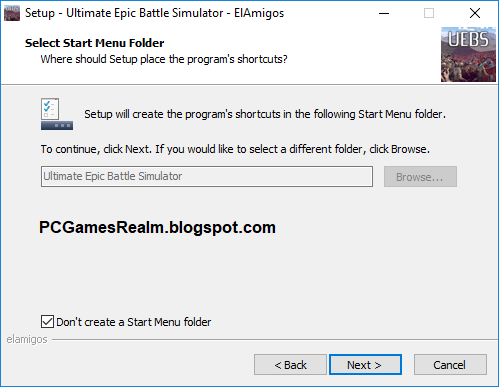
➤ Open and extract the file by using 7-Zip, and run 'setup.exe' as admin then install the game on your PC.
➤ Once the installation is complete, run the game's exe as admin and you can now play the game.
➤ Congratulations! You can now play this game for free on your PC.
➤ Note: If you like this video game, please buy it and support the developers of this game.
Turn off or temporarily disable your Antivirus or Windows Defender to avoid false positive detections.


5. SYSTEM REQUIREMENTS:
(Your PC must at least have the equivalent or higher specs in order to run this game.)
• Operating System: Windows 7, Windows Vista, Windows 8, Windows 10 | requires 64-bit
• Processor: Intel Core i5 4590 or AMD FX 8320 or any kind of higher processor
• Memory: at least 8GB System RAM
• Hard Disk Space: 5GB free HDD Space
• Video Card: AMD Radeon HD 5770 1024MB, NVIDIA GTS 450 1024MB or higher graphics
Supported Language: English and Simplified Chinese language are available and supported for this game.
If you have any questions or encountered broken links, please do not hesitate to comment below. :D

domingo, 15 de marzo de 2020

HOTT 52 - Battle 5 - A Final Desperate Battle

Battle 5 was fought over the weekend. The more I play, the more that setup finishes more quickly, and I remember the combat factors a lot more now. Less referring to the sheet and rules. However, each game finds me asking questions and I have a question from this week's battle below. But first, let's get to the action!

I generated both armies randomly. Both armies would consist of mostly militia and a few regular forces.

Humans
General - Sp x1
Spear (Sp) x3
Warband (Wb) x2   
Shooters (Sh) x4
Knight (Kn) x2
Orcs - defending
General - Wb x1
Warband (Wb) x3
Hordes (Hd) x2
Shooters (Sh) x3
Spear (Sp) x4

I thought about substituting fantasy elements (like Aerials, Magicians, Cleric, etc), but a toss of the dice said that wasn't happening.


I'm painting those Saxons as fast as I can to complete my Human warband elements. Hopefully they'll be done for next week's game! I don't like empty stands!

The Orc Warchief, Ib'Nuzgran, lines up his troops as a solid bunch.  He details a warband to remain behind in case the sneaky humans try to send a detachment down the road to sack their stronghold! The human commander, Major Nesbin, sees an opportunity and details his Knights to head down the road and see what trouble they can cause.


"Goblins to the front!" Ib'Nuzgran roars! The goblins rush ahead of the whip cracks from the orc sergeants, eager to taste human blood! Nesbin, seeing an opportunity to rain missile fire on the hordes, has his Shooters fold inwards as the goblins approach. The treacherous goblins then turn towards the wings, and Nesbin regretfully moves them back to keep the line intact.

Behind the goblins, the Bestials move forwards towards the approaching Human army.


The Human Shooters do their job, launching a hail of arrows on the exposed hordes. Their courage melts like snow in the sun and the goblins run away, ignoring the curses of the Orc sergeants. The lines draw close and then rush to attack! The Orc Warband drives through the Human lines, pushing their opponents back and pursuing with bloodlust!


Meanwhile, the Knights head down the road to see if they can sack the Orc stronghold. The warband left behind to guard it takes up a position in the woods near the road. The Knights are reluctant to take their hoses into the woods, so one element attempts to distract the Orcs while the other group of Knights attempts to swing around. Unfortunately, being so far away from their commander, it is hard to keep their attack organized! The Knight's attack falters as they delay in how to best approach the stronghold. (The distance is greater than 600p to their commander and the Kn are behind an impassable hill with woods - it requires 2 PIPs to move each element, instead of 1. With the battle focus on the line, as you'll see below, this is as far as the Kn got. If only the humans had a couple of better PIP rolls...)


The battle's momentum swings towards the Bestials as the Human attackers are pushed back or destroyed! However, the impetuous Orc Warchief breaks off from supporting his warband to attack the nearby Human Shooters. Recoiling from the Human's counterattack, the Orc Warlord finds himself behind the other Orc Warband, out of position should the Warband be forced to recoil! Lucky for Orcs, the warband fights on.

It turns grim for the humans. Only a Blade, the Majorand his command of Spears, and two Warbands remain of the line of Human attackers! The Bestials line is mostly intact and howling for human blood!


Nesmith sees an opportunity, however, and orders a desperate charge! The warbands and shooters surround the Orc Warchief and press the attack. The Warchief falls! The Bestials, disorganized and demoralized, retreat from the battle and their encampment. (6v1 in favor of the humans almost always guarantees a victory, as it did in this case. The odds were good for the humans for this bound, but had it not gone well, the Orcs were looking well on the way to victory.)

Humans win versus Bestials (Orcs/Goblins) (8 - 10G)

The Orc General didn't have many options when his surrounding elements were defeated, leaving him exposed. It was a close battle and with the Human line as wrecked as it was, there were going to be a lot of overlap situations when the lines closed again.

So my question came about with regards to when one element moves into contact with an enemy. For those of you who don't play HOTT/DBA (Hordes of the Things game is derived from the historical wargame De Bellus Antiquitatus), how elements contact each other and then "conform" (line up so that the elements are square with each other) is a whole set of precise rules - written in what is known as "Barkerese"! For comparison, the language (and organization) of 1st edition Advanced Dungeons & Dragons is similar to DBA/HOTT. 

My question came to who had to conform to whom, when a group contacts a group, and if supporting elements (elements in the 2nd rank that can add to the combat resolution of the elements in the front rank) also conformed. I ruled at the time in one way, but after a quick (and slightly embarrassing) newbie question/discussion posted to the HOTT Facebook group, I reread the rules and now I understand - when a group contacts a group, the conforming applies to the entire group, including supporting elements.

My shorthand for remember this is: Moving group conforms to standing group, single elements conform, otherwise, check the rules! It works for me... 

The other thing I (re)learned is that when moving through Bad Going, you move a group as a single column, or if you want to keep a line, those elements in Bad Going move as individual elements. It didn't come up this game, but has happened in previous games and I had forgotten that.

That's what I'm really enjoying, is this relearning and learning of little bits and elements. It feels just like AD&D/OD&D in that regards, and that just makes me happy.

On to Battle #6 next week!

jueves, 5 de marzo de 2020

Downlod Prince Of Percea The Sand Of Time Free


यहाँ सारे  गेम फ्री में मिलते है पासवर्ड भी आसान है


MINUMUM REQIRMENTS FOR THIS ram 2gb harddisk 1tbprocesorr intel pentuniuwindow7.8.10.xp(plese downlod winrar software to downlod this game)(plese downlod direct x setup for working this this game)(plese also dosable antvirus for working this game)

Prince of Persia: The Sands of Time is a third-person action-adventure puzzle-platform video game developed and published by Ubisoft. Revealed in March 2003, it was released across Game Boy Advance, PlayStation 2, GameCube, Xbox and Microsoft Windows in November 2003. The Sands of Time is a reboot of the Prince of Persia series, created by Jordan Mechner. Mechner served as creative consultant, designer, and scenario writer for The Sands of Time.
The game follows an unnamed Prince whose father sacks a Maharaja's city at the instigation of its treacherous Vizier. During the attack, the Prince obtains an artifact called the Dagger of Time, while his army captures an hourglass containing the Sands of Time. Visiting Azad to present the Sands as a gift to the city's ruler, the Vizier tricks the Prince into releasing the Sands, transforming the city's population into savage monsters. Together with the Maharaja's daughter Farah, the Prince works to correct his mistake and return the Sands to the hourglass. The gameplay revolves around the Prince's platforming abilities, broken up by fights with the creatures created by the Sands. A key mechanic in the game is using the Dagger to rewind time if the Prince makes a mistake platforming, and using it to kill and freeze enemies.
Concept work began in spring of 2001, after Ubisoft acquired the Prince of Persia catalog. After Mechner was brought on board, production began in June of that year. After the initial story draft was scrapped as it was too complex, the team began with four guiding concepts, including the ability to rewind time: this idea grew into the Dagger, the Sands, and the various powers related to them. Mechner's script drew inspiration from the Shahnameh, with the main focus on creating a simple narrative that worked with the pace of gameplay. The game used Ubisoft's Jade engine, originally designed for beyond evi Good & Evil, another game published by the company. Production was troubled, with the team facing problems with the engine structure and delays with environment assets, while also managing to create an effective tester network to seek out the game's bugs. In 2004, a version for mobile phones was developed and published in North America by Gameloft.
Upon release, it received critical acclaim, won and was nominated for numerous awards, and has been recognized by many as one of the greatest games of all time. Sales of the title were initially slow, but it eventually became a commercial success. Its success prompted the development of a sequel, Prince of Persia: Warrior Within, which was released in November 2004. Further games set in the Sands of Time continuity have been developed, and it is generally cited as the reason for the Prince of Persia series' return to fame.
DOWNLOD FROM HERE
NO ANY PART AVLABLE DIRECT SETUP DOWNLOADplese also downlod win rar softawre and direc x


how to fix problem in this game
  1. no stsrting game besuse you could not download direct x 9.0
  2. you cond not downlod winrar sofawre
  3. you have not downlod in internet downlod manager
  4. you have low processor
  5. you have low ram 
  6. you have not odisable antivirus
 media fire
downlod from here thanq


Movie Reviews: Ready Player One, Game Night, Three Billboards Outside Ebbing Missouri, The Phantom Thread, Loving Vincent

See all of my movie reviews.

Sorry guys; five disappointing movies ...

Ready Player One: From Steven Spielberg, this is a shallow, uninteresting movie is about a guy who plays in a virtual world looking for three Easter eggs, or "keys", so that he can gain ownership of the company that owns the virtual world. While he is at it, others are also looking for the keys, one of whom is a woman who joins him as love interest (along with some other guild members), as well as certain high-financed players backed by people who are willing to kill you in the real world if they discover who you are and that you are a competitor.

Within five minutes of the start of the movie I found myself not caring about the boy or anyone else, since there is zero character development. Astonishingly, the amount I cared continued to drop as the movie went along. I didn't think that was possible, since I already didn't care at all, but I managed to continue to care less and less. I eventually figured out that this was because the score was very good. It cued me into thinking, every once in a while, that something that I might care about was about to occur. Each time, however, this never happened.

The amusement of the movie is supposed to come from a) watching other people play video games, which is a colossal bore (unless the player knows how to fill the time with snarky commentary, as people often do on YouTube), and b) seeing hundreds of throwbacks to 1980s video games and fiction. Unlike recent media in which this worked, such as Stranger Things and even Super 8 to an extent, it did not work here. I didn't get 90% of the references, and, anyway, simply seeing references on screen is not what made those other media good; the other media had good stories. And, I guess, we are supposed to be amused by c) the suspense as to whether the main character will solve the rather obvious and uninteresting puzzles and ultimately find the keys and triumph. Duh.

There is not a scrap of emotion in the entire movie. Someone gets killed at one point, but it's someone who we were barely introduced to and who is not shown as having any emotional connection to the main character. I am really in shock at this. This is the emotionally manipulative director who brought us Jaws? E.T.? Shindler's List? Bridge of Spies?

Whatever. I guess, while it is a useless and dull movie, it is not particularly offensive, at least. Oh wait, it is: at the end of the movie the narrator tells us that we shouldn't be spending all of our time playing video games / in virtual reality, but should instead interact with each other more in the real world. Thanks for that very important message; never would have known that.

One more thing that irritated me: T.J. Miller played the exact same character in this movie that he played in Silicon Valley. I liked it in Silicon Valley, but it was pretty out of place here.

Game Night: This is ninety minutes of one joke, the kind of joke that is funny only if it comes once, unexpectedly, in the middle of an otherwise serious situation, but is not funny when it comes repeatedly for ninety minutes. This is a farcical remake of The Game (1997, Michael Douglas). Instead of a strange combination of gaslighting, pursuit, and trying to figure out what is going on as the terror mounts, in this movie the terror happens, but everyone keeps making stupid jokes. It's supposed to be funny, because they keep making light of things while bad things happen; that's the one and only joke, really. The acting, directing, and cinematography were fine. Jason Bateman and Rachel McAdams are always cute.

The movie that did this well is The Man Who knew Too Little (1997, Bill Murray), which was a cute and silly movie. I was appalled enough at this movie to happily walk outside the movie theater twice to answer phone calls (I had it on vibrate, guys). If my friends hadn't been with me in the theater, I would have gone home and not gone back in to the theater to finish the movie. In the movie's defense, my friends liked it. They said that they like to see a mindless, silly movie once in a while (I think that's a slight directed at me and my movie choices).

Three Billboards Outside Ebbing Missouri: This is a well-acted, grim piece of midwest Americana. Mildred's (Fances McDermott) daughter was raped and murdered several months ago, but she hasn't heard anything from the police who are busy (according to her) chasing and shooting blacks who aren't really doing anything. So she puts up some billboards that pointedly call out the chief of police (Woody Harrelson) in a low-trafficked area. What makes it interesting is that a) she is actually friends with the chief of police, b) the chief is dying of cancer and should really not be at work, and c) the rest of the police dept doesn't take kindly to this, especially one lunatic racist violent hotheaded police creep. Things come to a boil, especially after the police chief shoots himself.

This movie is relentlessly depressing, representing a lot of the worst aspects of American prejudice, violence, despair, and hatred. Just about nobody supports Midred, not even her son. Interestingly, the lunatic police guy actually makes a kind of (unbelievable) change around two thirds into the movie. This should have given us a bit of hope. However, the movie ends just as bleakly and miserably as it started.

Other than being relentlessly depressing, what actually ruins the movie for me are the multiple acts of outrageous criminal behavior performed by multiple people on multiple occasions, some of it incredibly brutal and most of it performed in sight of multiple witnesses. These acts are done and never have repercussions. And I'm not saying that the bad guys weasel their way out of repercussions, I'm saying that the movie doesn't seem to believe that any reactions by the witnesses or police is expected. What the hell? Is this a video game? While I expect to sometimes find injustice in the system, the system still exists; treating violence like it's just a video game broke the reality of the movie for me.

The movie has compelling performances and some good ideas, but it's ultimately not realistic enough to recommend.

The Phantom Thread: Daniel Day Lewis gives another astounding performance as Reynolds, a dressmaker / bachelor / bully and all around a**hole in 1950s London. He is joined by other great performances by Vicky Krieps, Lesley Manville, and everyone else in this beautifully shot and artfully scripted period piece about a dressmaker who obsessively creates beautiful dresses, but only if his cadre of assistants take care of his other needs and none of them interrupts his "solitary genius" thinking. This genius is, apparently, sufficient excuse for everyone to give him his way, and for him to throw toxic vitriol at anyone who expresses any kind of opinion, presence, or personality. Like a spoiled baby, as one of the other main characters eventually says.

Krieps plays a waitress, Anna, who is drawn to this bully and who follows him to London to be a dress model and eventually a lover. She falls deeply in love with him - because he is such a genius - and even goes and does some of his bullying for him, both - because he is such a genius - and because she hopes he will one day fall in love with her and allow her to butter her toast in his presence without cursing her out. Even taking into account that this is the 1950s, she is really pathetic; in the first two thirds of the movie, not a moment is shown where she has a relationship with anyone else but him. No family? No friends or neighbors at all?

SPOILERS follow, because really you shouldn't watch this movie, and if you do you should be prepared for what happens.

Anna has a little strength in her, just enough to keep wanting him to love her. And so, one day after she suffers great abuse from him, she poisons him, and he falls sick and can't work for the next few days he is too sick to abuse her, so she is happy. And then, he comes back from his illness and proposes to her.

Okay ... but maybe he doesn't know that she poisoned him?

After the marriage, things go back to as they were, obviously, and he begins to heap abuse at her again until one day she overhears him complaining about how he doesn't want her around as she is disrupting his work. So she poisons him again, and this time he knows it and goes along with it. And he loves her.

And that's the movie. Okay...

So this is a sick, toxic (literally) relationship that works for both of them. She is only happy when he is poisoned and helpless, and he, despite his passion and perfection for work is apparently only able to love her when his work is taken from him and he is poisoned and helpless. Apparently he makes the choice to let her poison him. Perhaps he really doesn't want the endless pressure of being a genius after all? It's hard to say, as the screenwriter leaves it a mystery.

Like Whiplash, I recognize great performances and interesting screenplay, but I can't watch it. Who really wants to watch two hours of repulsive people, where the main character is an abusive, horrible person? A little bit of it in a movie adds color. You know that the scriptwriter threw it in for you to not like the abusive character. But, if the whole movie is about an abusive character who doesn't learn the error of his ways, you get the impression that the scriptwriter thinks that we should be entertained by it, or even sympathetic to this toxic white privileged male jerk.

But I wasn't. And I wasn't. I was simply repulsed. And the perfect "solitary genius" who is too important to be bothered with having to be nice to people is a myth.

Loving Vincent: Like a number of other animations I have reviewed, this work is one of astounding, gorgeous animation but also utterly boring. The plot, such as it is, is ... um ... well, there isn't one. A police officer wanders around trying to deliver a letter and asks a few questions about how Van Gogh died. It is all shots, and scenes, and music, and flaccid unimportant dialog. And nothing happens and there are no characters.

Blending Narrative, Art And Mechanics In A Majestic Way: The Immersive Experience Of “The Gardens Between”

Attention: this post contains spoilers from the game "The gardens between"

I've been playing games since I was a child. Now 41 years old, I'm proud to say that I've been a videogame player since the first generation of consoles that were raised on Earth. I'm a lucky person that has had the opportunity to play many kinds of different games in the last 38 years.

Unfortunately, today, I don't have time to play all the games I want. So, when I'm choosing a game to play I'm very meticulous; I talk with gamer friends, I watch YouTube reviews and I try to read a lot about games. Nowadays, what do I search for in a game to play? I try to choose the minimum of three features: a good narrative, a creative gaming mechanics and an interesting aesthetic. If I can find a game with three of these features, I'll probably play it with much more enthusiasm and immersion.

The last game I played that filled the three features was "The gardens between".


I'll start to talk about the narrative feature: the game is a beautiful story about two children on the last day they have together as neighbors; the boy is moving to another city and the story of the game is about them remembering the adventures of their childhood together.

The narrative feature is the basis for a stunning art direction: the game's atmosphere is full of childish elements but, on another hand, you can notice signs of fear, sorrow and depression. It's about dark and light; about remembering the past but, at the same time, trying to move on.

To blend the narrative layer with the aesthetic layer we have a very interesting mechanics that uses time travel as the basis for puzzle solutions. The simplicity of the commands are great: you put the joystick to the right to advance the events in time, you put left and they come back to their original places. So, what's the challenge? The game creates timing distortions to make the player constantly think about the sequence of movements he needs to make. Check the video below to understand how everything connects in "The gardens between".


In this context it is interesting to say how we have a large list of indie games that can fill the previous features that I mentioned. Today, it's not a privilege from the triple A games to have great narrative with stunning art and challenging mechanics. By the way, most of the time when I'm searching for this kind of game I'll probably choose an indie to download.

#GoGamers

miércoles, 4 de marzo de 2020

Exploring Monster Taming Mechanics In Final Fantasy XIII-2: Data Collection

The monster taming aspect of Final Fantasy XIII-2 is surprisingly deep and complex, so much so that I'm interested in exploring it in this miniseries by shoving the monster taming data into a database and viewing and analyzing it with a website made in Ruby on Rails. In the last article, we learned what monster taming is all about and what kind of data we would want in the database, basically roughing out the database design. Before we can populate the database and start building the website around it, we need to get that data into a form that's easy to import, so that's what we'll do today.

Starting a Data Parsing Script

We already identified a good source for most of the data we want to use from the Monster Infusion FAQ post on Gamefaqs.com. However, we don't want to type the thousands of lines of data from this FAQ into our database because we would be introducing human error with the data copying, and the writers of this FAQ have already gone through all of the trouble of entering the data the first time, hopefully without mistakes. Besides, why would we go through such a tedious process when we could have fun writing a script to do the work for us? Come on, we're programmers! Let's write this script.

Since the website will eventually be in Ruby on Rails, we might as well write this script in Ruby, too. It's not absolutely necessary to write the script in Ruby because it's a one-off deal that will only be run once (when it works) to convert the text file into a format that we can easily import into a database, but Ruby is pretty darn good at text processing, so let's stick with it. I like writing scripts in stages, breaking things down into simple problems and starting with an easy first step, so let's do that here. The simplest thing we can do is read in the text file after saving the FAQ to a local file. To add a bit of debug to make sure we have the file read in, let's scan through and print out the section header for the data we're looking for in the file:
File.foreach("ffiii2_monster_taming_faq.txt") do |line|
if line.include? "MLTameV"
puts line
end
end
Already, this code gives the basic structure of what we're trying to do. We're going to read in the file, loop through every line, look for certain patterns, and output what we find that matches those patterns. The real deal will be much more complex, but it's always good to have a working starting point.

This code also has a few problems that we may or may not want to do anything about. First, it's just hanging out in the middle of nowhere. It's not in a class or function or anything more structured. If this was going to be a reusable parsing tool for converting various FAQs into rows of data, I would definitely want to engineer this code more robustly. But hey, this is a one-off script, and it doesn't need all of that extra support to make it reusable. Over engineering is just a waste of time so we'll leave this code out in the open.

Second, I've got two constant strings hard-coded in those lines: the file name and the search string. I may want to stick the search string in a variable because it's not terribly obvious what "MLTameV" means. The file name, on the other hand, doesn't need to be in a variable. I plan to keep this part of the code quite simple, and it's the obvious loop where the file is read in. On top of that, this code will be very specific to handling this exact file, so I want the file name to be tightly coupled to this loop. If the script is ever copied and modified to work on a different file, this file name string can be changed in this one place to point to the new file that that script works with. I don't see a need to complicate this code with a variable.

Third, when this code runs, it prints out two lines instead of one because there's another instance of "MLTameV" in the table of contents of the file. For locating the place to start parsing monster data, we want the second instance of this string. One way to accomplish this task is with the following code:
SECTION_TAG = "MLTameV"
section_tag_found = false

File.foreach("ffiii2_monster_taming_faq.txt") do |line|
if section_tag_found and line.include? SECTION_TAG
puts line
elsif line.include? SECTION_TAG
section_tag_found = true
end
end
Now only the section header line is printed when this script is run. However, as what inevitably happens when we add more code, we've introduced a new problem. It may not be obvious right now, but the path that we're on with the section_tag_found variable is not sustainable. This variable is a piece of state that notifies the code when we've seen a particular pattern in the text file so we can do something different afterward. When parsing a text file using state variables like this one, we'll end up needing a lot of state variables, and it gets unmanageable and unreadable fast. What we are going to need instead, to keep track of what we need to do next, is a state machine.

Parsing Text with a Finite State Machine

Finite state machines (FSM) are great for keeping track of where you are in a process and knowing which state to go to next, like we need to know in the case of finding the section header for the list of tamable monsters in this text file. In the FSM we always have a current state that is one of a finite number of states, hence the name. Depending on the input in that state, the FSM will advance to a next state and possibly perform some output task. Here is what that process looks like in Ruby for finding the second section tag:
SECTION_TAG = "MLTameV"

section_tag_found = lambda do |line|
if line.include? SECTION_TAG
puts line
end
return section_tag_found
end

start = lambda do |line|
if line.include? SECTION_TAG
return section_tag_found
end
return start
end

next_state = start
File.foreach("ffiii2_monster_taming_faq.txt") do |line|
next_state = next_state.(line)
end
First, the states are defined as lambda methods so that they can easily be passed around as variables, but still called as functions. These variables have to be declared before they're used, so the section_tag_found method either has to be defined first because the start method uses it, or all methods could be predefined at the start of the file and then redefined with their method bodies in any desired order. Another way to define these states would be to wrap the whole thing in a class so that the states are class members, but that kind of design would be more warranted if this FSM was part of a larger system. As it is, this parser will be almost entirely made up of this FSM, so we don't need to complicate things.

We can also represent this FSM with a diagram:


The FSM starts in the Start state, obviously, and it transitions to the Section Tag Found state when there's a matching SECTION_TAG. The unlabeled lines pointing back to the same states mean that for any other condition, the state remains unchanged. This diagram is quite simple, but when the FSM gets more complex, it will definitely help understanding to see it drawn out.

Notice that running through the lines of the text file in the foreach loop became super simple. All that's necessary is to feed each line into the next_state, and assign the return value as the new next_state. The current state is kind of hidden because we're assigning the next_state to itself. Also notice that we need to be careful to always return a valid state in each path of each state method, even if it's the same state that we're currently in. Inadvertently returning something that was not a valid state would be bad, as the FSM is going to immediately try to call it on the next line.

Now that we have an FSM started, it'll be easy to add more states and start working our way through the tamable monster data. What do we need to look for next? Well, we can take a look at the data for one monster and see if there are any defining characteristics:
...............................................................................

MONSTER 001

Name---------: Apkallu Minimum Base HP------: 1,877
Role---------: Commando Maximum Base HP------: 2,075
Location-----: Academia 500 AF Minimum Base Strength: 99
Max Level----: 45 Maximum Base Strength: 101
Speed--------: 75 Minimum Base Magic---: 60
Tame Rate----: 10% Maximum Base Magic---: 62
Growth-------: Standard
Immune-------: N/A
Resistant----: N/A
Halved-------: All Ailments
Weak---------: Fire, Lightning
Constellation: Sahagin

Feral Link-----: Abyssal Breath
Description----: Inflicts long-lasting status ailments on target and nearby
opponents.
Type-----------: Magic
Effect---------: 5 Hits, Deprotect, Deshell, Wound
Damage Modifier: 1.8
Charge Time----: 1:48
PS3 Combo------: Square
Xbox 360 Combo-: X

Default Passive: Attack: ATB Charge
Default Skill--: Attack
Default Skill--: Ruin
Default Skill--: Area Sweep
Lv. 05 Skill---: Powerchain
Lv. 12 Passive-: Strength +16%
Lv. 18 Skill---: Slow Chaser
Lv. 21 Skill---: Scourge
Lv. 27 Passive-: Strength +20%
Lv. 35 Passive-: Resist Dispel +10%
Lv. 41 Passive-: Strength +25%
Lv. 42 Passive-: Resist Dispel +44%
Lv. 45 Skill---: Ruinga

Special Notes: Apkallu only spawns twice in Academia 500 AF. If you fail to
acquire its Crystal in both encounters, you will have to close
the Time Gate and replay the area again.

...............................................................................
That series of dots at the beginning looks like a good thing to search for. It repeats at the start of every monster, so it's a good marker for going into a monster state. We'll also want to pass in a data structure that will be used to accumulate all of this monster data that we're going to find. To make it easy to export to a .csv file at the end, we're going to make this data structure an array of hashes, and it looks like this with the new state:
SECTION_TAG = "MLTameV"
MONSTER_SEPARATOR = "........................................"

new_monster = lambda do |line, data|
if line.include? MONSTER_SEPARATOR
return new_monster, data << {}
end
return new_monster, data
end

section_tag_found = lambda do |line, data|
if line.include? SECTION_TAG
return new_monster, data
end
return section_tag_found, data
end

start = lambda do |line, data|
if line.include? SECTION_TAG
return section_tag_found, data
end
return start, data
end

next_state = start
data = []
File.foreach("ffiii2_monster_taming_faq.txt") do |line|
next_state, data = next_state.(line, data)
end

puts data.length
I shortened the MONSTER_SEPARATOR pattern in case there were some separators that were shorter than the first one, but it should still be plenty long to catch all of the instances of separators between monsters in the file. Notice that we now have to pass the data array into and out of each state method so that we can accumulate the monster data in it. Right now it simply appends an empty hash for each monster it finds. We'll add to those hashes in a bit. At the end of the script, I print out the number of monsters found, which we expect to be 164, and it turns out to be a whopping 359! That's because that same separator is used more after the tamable monster section of the file, and we didn't stop at the end of the section. That should be easy enough to fix:
SECTION_TAG = "MLTameV"
MONSTER_SEPARATOR = "........................................"
NEXT_SECTION_TAG = "SpecMon"

end_monsters = lambda do |line, data|
return end_monsters, data
end

new_monster = lambda do |line, data|
if line.include? MONSTER_SEPARATOR
return new_monster, data << {}
elsif line.include? NEXT_SECTION_TAG
return end_monsters, data
end
return new_monster, data
end

# ...
I added another state end_monsters that consumes every line to the end of the file, and we enter that state from the new_monster state if we see the NEXT_SECTION_TAG. Now if we run the script again, we get a count of 166 monsters. Close, but still not right. The problem is that there are a couple extra separator lines used in the tamable monster section, one after the last monster and one extra separator after a sub-heading for DLC monsters. We're going to have to get a bit more creative with how we detect a new monster. If we look back at the example of the first monster, we see that after the separator the next text is MONSTER 001. This title for each monster is consistent for all of the monsters, with MONSTER followed by a three digit number. Even the DLC monsters have this tag with DLC in front of it. This pattern is perfect for matching on a regular expression (regex).

Finding Monster Data with Regular Expressions

A regex is a text pattern defined with special symbols that mean various things like "this character is repeated one or more times" or "any of these characters" or "this character is a digit." This pattern can be used to search a string of text, which is called matching the regex. In Ruby a regex pattern is denoted by wrapping it in forward slashes (/), and we can easily define a regex for our MONSTER 001 pattern:
SECTION_TAG = "MLTameV"
MONSTER_SEPARATOR = "........................................"
NEXT_SECTION_TAG = "SpecMon"
NEW_MONSTER_REGEX = /MONSTER\s\d{3}/

find_separator = nil

end_monsters = lambda do |line, data|
return end_monsters, data
end

new_monster = lambda do |line, data|
if NEW_MONSTER_REGEX =~ line
return find_separator, data << {}
elsif line.include? NEXT_SECTION_TAG
return end_monsters, data
end
return new_monster, data
end

find_separator = lambda do |line, data|
if line.include? MONSTER_SEPARATOR
return new_monster, data
end
return find_separator, data
end

# ...
The NEW_MONSTER_REGEX is defined as the characters MONSTER, followed by a space (\s), followed by three digits (\d). I changed the new_monster state to look for a match on our new regex, and added a find_separator state to still search for the MONSTER_SEPARATOR. Notice that the FSM will bounce between these two states, so the state that's defined later has to be declared at the top of the file, otherwise Ruby will complain that find_separator is undefined in new_monster.

These regex patterns are useful and powerful, but they can also be quite tricky to get right, especially when they get long and complicated. We'll be using them to pull out all of the data we want from each monster, but we'll try to keep them as simple as possible. The next regex is more complicated, but it will allow us to pull nearly all of the properties for each monster and put it into the empty hash that was added to the list of hashes for that monster. Ready? Here it is:
MONSTER_PROP_REGEX = /(\w[\w\s\.]*\w)-*:\s(\S+(?:\s\S+)*)/
We'll break this regex apart and figure out what each piece means separately.

The first part of the regex, (\w[\w\s\.]*\w), is surrounded by parentheses and is called a capture. A capture will match on whatever the pattern is inside the parentheses and save that matching text so that it can be accessed later. We'll see how that works in the code a little later, but right now we just need to know that this is how we're going to separate out the property name and its value from the full matching text. This particular capture is the property name, and it starts with a letter or number, symbolized with \w. The stuff in the brackets means that the next character can be a letter or number, a space, or a period. Any of those characters will match. Then the following '*' means that a string of zero or more of the preceding character will match. Finally, the property name must end with a letter or number, symbolized with \w again. The reason this pattern can't just be a string of letters and numbers is because some of the property names are multiple words, and the "Lv. 05 Skill" type properties also have periods in them. We want to match on all of those possibilities.

The next part of the regex is -*:\s, which simply means it will match on zero or more '-', followed by a ':', followed by a space. Reviewing the different lines for the MONSTER 001 example above, we can see that this pattern is indeed what happens. Some cases have multiple dashes after the property name, while others are immediately followed by a colon. The colon is always immediately followed by a single space, so this should work well as our name-value separator. It's also outside of any parentheses because we don't want to save it for later.

The last part of the regex is another capture for the property value: (\S+(?:\s\S+)*). The \S+—note the capital S—will match on one or more characters that are not white space. It's the inverse of \s. The next thing in this regex looks like yet another capture, but it has this special '?:' after the open parenthesis. This special pattern is called a grouping. It allows us to put a repeat pattern after the grouping, like the '*' in this case, so that it will match on zero or more of the entire grouping. It will not save it for later, though. Since this grouping is a space followed by one or more non-space characters, this pattern will match on zero or more words, including special characters. If we look at the example monster above, we see that this pattern is exactly what we want for most of the property values. Special characters are strewn throughout, and it would be too much trouble to enumerate them all without risking missing some so we cover our bases this way.

Fairly simple, really. We're going to match on a property name made up of one or more words, followed by a dash-colon separator, and ending with a property value made up of one or more words potentially including a mess of special characters. Note how we couldn't have used the \S character for the property name because it would have also matched on and consumed the dash-colon separator. We also could not have used the [\s\S]* style pattern for the words in the property value because it would have matched on any number of spaces between words. That wouldn't work for the first few lines of the monster properties because there are two name-value pairs on those lines. Now that we have our regex, how do we use those captured names and values, and how exactly is this going to work for the lines with two pairs of properties on them? Here's what the new add_property state looks like with some additional context:
# ...

MONSTER_PROP_REGEX = /(\w[\w\s\.]*\w)-*:\s(\S+(?:\s\S+)*)/

find_separator = nil
new_monster = nil

end_monsters = lambda do |line, data|
return end_monsters, data
end

add_property = lambda do |line, data|
props = line.scan(MONSTER_PROP_REGEX)
props.each { |prop| data.last[prop[0]] = prop[1] }
return new_monster, data if line.include? MONSTER_SEPARATOR
return add_property, data
end

new_monster = lambda do |line, data|
if NEW_MONSTER_REGEX =~ line
return add_property, data << {}
elsif line.include? NEXT_SECTION_TAG
return end_monsters, data
end
return new_monster, data
end

# ...
The double-property lines are handled with a different type of regex matcher, line.scan(MONSTER_PROP_REGEX). This scan returns an array of all of the substrings that matched the given regex in the string that it was called on. Conveniently, if the regex contains captures, the array elements are themselves arrays of each of the captures. For example, the scan of the first property line of our MONSTER 001 results in this array:
[['Name', 'Apkallu'],['Minimum Base HP', '1,877']]
We can simply loop through this array, adding property name and property value to the last hash in the list of hashes. Then, if the line was actually the MONSTER_SEPARATOR string, it didn't match any properties and we'll move on to the next monster. Otherwise, we stay in the add_property state for the next line.

One last thing that we're not handling is those multi-line descriptions and special notes. We need to append those lines to the correct property when we come across them, but how do we do that? Keep in mind that these extra lines won't match on MONSTER_PROP_REGEX, so we can simply detect that non-match, make sure it's not an empty line, and add it to the special notes if it exists or the description if the special notes doesn't exist. Here's what that code looks like in add_property.
MONSTER_PROP_EXT_REGEX = /\S+(?:\s\S+)*/

# ...

add_property = lambda do |line, data|
props = line.scan(MONSTER_PROP_REGEX)
props.each { |prop| data.last[prop[0]] = prop[1] }
return new_monster, data if line.include? MONSTER_SEPARATOR

ext_line_match = MONSTER_PROP_EXT_REGEX.match(line)
if props.empty? and ext_line_match
if data.last.key? 'Special Notes'
data.last['Special Notes'] += ' ' + ext_line_match[0]
else
data.last['Description'] += ' ' + ext_line_match[0]
end
end

return add_property, data
end
By putting the extra code after the return if the line is the MONSTER_SEPARATOR, we can assume that this line is not the MONSTER_SEPARATOR and just check if the MONSTER_PROP_REGEX didn't match and there's something on the line. Then decide on which property to add the line to, and we're good to go.

Okay, that was a lot of stuff, so let's review. First, we read in the file that we wanted to parse that contains most of the monster taming data we need. Then, we loop through the lines of the file, feeding them into a FSM in order to find the section of the file where the list of monsters is and separate each monster's properties into its own group. Finally, we use a few simple regex patterns to capture each monster's property name-value pairs and add them to a list of hashes that will be fairly easy to print out to a .csv file later. All of this was done in 66 lines of Ruby code! Here's the program in full so we can see how it all fits together:
SECTION_TAG = "MLTameV"
MONSTER_SEPARATOR = "........................................"
NEXT_SECTION_TAG = "SpecMon"
NEW_MONSTER_REGEX = /MONSTER\s\d{3}/
MONSTER_PROP_REGEX = /(\w[\w\s\.]*\w)-*:\s(\S+(?:\s\S+)*)/
MONSTER_PROP_EXT_REGEX = /\S+(?:\s\S+)*/

find_separator = nil
new_monster = nil

end_monsters = lambda do |line, data|
return end_monsters, data
end

add_property = lambda do |line, data|
props = line.scan(MONSTER_PROP_REGEX)
props.each { |prop| data.last[prop[0]] = prop[1] }
return new_monster, data if line.include? MONSTER_SEPARATOR

ext_line_match = MONSTER_PROP_EXT_REGEX.match(line)
if props.empty? and ext_line_match
if data.last.key? 'Special Notes'
data.last['Special Notes'] += ' ' + ext_line_match[0]
else
data.last['Description'] += ' ' + ext_line_match[0]
end
end

return add_property, data
end

new_monster = lambda do |line, data|
if NEW_MONSTER_REGEX =~ line
return add_property, data << {}
elsif line.include? NEXT_SECTION_TAG
return end_monsters, data
end
return new_monster, data
end

find_separator = lambda do |line, data|
if line.include? MONSTER_SEPARATOR
return new_monster, data
end
return find_separator, data
end

section_tag_found = lambda do |line, data|
if line.include? SECTION_TAG
return find_separator, data
end
return section_tag_found, data
end

start = lambda do |line, data|
if line.include? SECTION_TAG
return section_tag_found, data
end
return start, data
end

next_state = start
data = []
File.foreach("ffiii2_monster_taming_faq.txt") do |line|
next_state, data = next_state.(line, data)
end
And here's the corresponding FSM diagram:

Final FSM diagram of tamable monster parser

We still need to write the collected data out to a .csv file so that we can import it into a database, but that is a task for next time. Also, notice that we have done almost no data integrity checks on this input other than what the FSM and regex patterns inherently provide. Any mistakes, typos, or unexpected text in the file will likely result in missing or corrupt data, so we'll need to do some checks on the data as well. Additionally, this data is just the tamable monster data. We still need the other table data for abilities, game areas, monster materials, and monster characteristics. However, this is a great start on the data that was the most difficult to get, and we ended up with quite a few extra properties that we weren't intending to collect in the list. That's okay, I'm sure we'll find a use for them.

Download Need For Speed: Hot Pursuit

Download Need for Speed: Hot Pursuit


===============================================

How To Install NFS HOT PURSUIT
 
without Errors and Problems


===============================================

🔶🔴🔶🔶🔴🔶 DOWNLOAD HERE 🔶🔴🔶🔶🔴🔶

🌹 Please use IDM (Internet Download Manager) to download the files without any error.

=======================================


💘 To Download Latest Movies In 720P & 1080P Visit My Other Site :- https://www.worldfree4utechno.ml/

Cyber Hunter PC Version :- 


=======================================

Please Install "7-zip and WINRAR" to extract the files.

💘 Download Winrar :-
🌹  (32bit PC)
🌹  (64bit PC)

💘 Visual C++ Redistributable 2012 :-
🌹 Download

If your PC has no net framework then, you can
download net framework from here :-

💘 net framework 4.6
🌹 Download

💘 IMPORTANT 💘:-
🌹 ALWAYS DISABLE YOUR ANTIVIRUS BEFORE EXTRACTING THE FILES.
----------------------------------------------

Thank You For Watching My Video.....

We Are Thank Full To You...

And Don't Forget To Subscribe To My Channel...

And Keep Visiting Our Channel, Keep Supporting Our Channel, And Keep Loving Our Channel ...

Thank You So Much................
----------------------------------------------------------------------

THANK YOU SOO MUCH FOR VISITING OUR SITE.